
Table of Contents
- I. Deep Dive into Bioacoustics: The Physical and Physiological Mechanisms Behind Huskies’ Nighttime Howling
- II. Four Common Acoustic Types of Huskies’ Nighttime Howling
- III. Traditional Behavioral Observation vs. ChatoPet AI Sound Recognition (Acoustic AI)
- IV. Solution: Using ChatoPet’s Neural Network (Neural Bridge) for Nighttime Behavior Adjustment
- V. Frequently Asked Questions (FAQ Zone)
I. Deep Dive into Bioacoustics: The Physical and Physiological Mechanisms Behind Huskies’ Nighttime Howling
Huskies (West Siberian/Siberian Husky) retain highly ancestral canine vocal communication mechanisms at the genetic level. Unlike typical barking, howling is along-range, low-frequency acoustic signalthat penetrates exceptionally well through denser nighttime air.
From a bioacoustic perspective, husky howls exhibit the following characteristic physical features:
- Fundamental Frequency (F0):Typically falls within the range of 300 Hz to 800 Hz and displays strong harmonic structure.
- Zero-Crossing Rate (ZCR):Compared with sharp, noisy sounds like biting or alert barking, howls have a significantly lower ZCR—producing smooth, continuous sinusoidal waveforms.
- Acoustic Energy Distribution:Energy is heavily concentrated in the mid-to-low frequency range, enabling the sound to travel several kilometers in open environments.
At night, ambient background noise drops markedly, heightening huskies’ sensitivity to internal physiological states—such as boredom, loneliness, or separation anxiety—as well as subtle external stimuli—like distant alarm sirens or low-frequency atmospheric cues preceding thunderstorms—triggering their genetically ingrained howling reflex.
II. Four Common Acoustic Types of Huskies’ Nighttime Howling
To accurately identify the cause of a husky’s nighttime howling, we classify its spectrogram and acoustic tonality:
| Howl Type | Dominant Emotion/Intention | Physical Acoustic Features (F0 / Energy Distribution) | Typical Behavioral Signs |
|---|---|---|---|
| Separation-Induced | Distress, attention-seeking, fear | High fundamental frequency (F0 > 550 Hz), ending with faint whimpering tones and exhibiting highly regular periodicity | Pacing, scratching at doors, and resisting sleep |
| Environmentally triggered | Reacting to alarm sounds or unexpected noises; territorial vigilance | Alternating mid- to high-frequency toneswith rapid onset (very short attack time), matching the frequency of external sounds | Lifting head to gaze upward at the ceiling or out the window, ears pricked |
| Social isolation–related | Seeking stimulation or companionship to expend energy | Sustained, steady tonewith stable frequency between 350–450 Hz and sustained high harmonics | Lying in the bed dazed, emitting intermittent howls |
| Physically discomfort–related | Pain, aging, or joint stress | Low-frequency tones interspersed with sharp, brief soundswith irregular energy distribution and fragmented waveform patterns | Stiff posture, difficulty rising, frequent position changes overnight |
III. Traditional behavioral observation vs. ChatoPet AI acoustic analysis
In the past, pet owners often relied solely on subjective interpretation to infer what a husky’s vocalizations meant. Yet ChatoPet introduces neural-network–based acoustic decoding technology—shifting analysis from guesswork to quantifiable assessment.
[ 传统经验猜测 ]  ---- (存在主观偏差 / 无法实时监测) ----> 治标不治本

[ ChatoPet AI 声纹分析 ] -> (Librosa/多模态神经网络算法) -> [ F0/ZCR 声谱图特征 ] -> 实时解码真实情绪
1. Multimodal neural network emotion decoding (Neural Voice Engine)
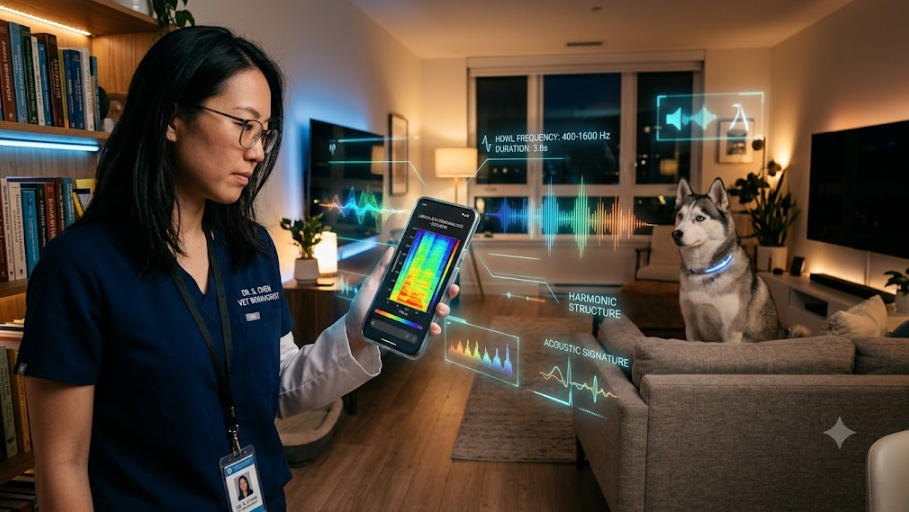
ChatoPet’s Neural Voice Engineintegrates extensive real-world animal behavior models and bioacoustic data. When a smartphone or smart device captures a husky’s nighttime howling, the algorithm performs second-level audio preprocessing and feature extraction in the cloud:
- Noise reduction:Automatically filters out ambient nighttime noise, such as wind or air conditioner hum.
- Time-domain and frequency-domain decomposition:Analyzes the F0 (fundamental frequency) contour and short-term energy fluctuations in the audio signal.
- Emotion mapping:Maps spectral features to ChatoPet’s emotion database, delivering an immediate diagnostic output (e.g., 87% likelihood of attention-seeking behavior caused by separation anxiety.
🐾 Try the AI-powered pet sound analyzer
Not sure why your Husky is howling? Upload a 5-second audio clip of nighttime howling to instantly generate a Librosa spectrogram and identify emotional cues—free of charge. Upload and analyze now.
IV. Solutions: Using ChatoPet’s neural network (Neural Bridge) for nighttime behavioral correction
Once the underlying cause is identified, resolving nighttime howling in Huskies requires establishingappropriate acoustic conditioning and environmental soothing.
Step 1: Record and analyze nighttime audio (Capture & Decode)
Place a microphone in the area where your Husky exhibits nighttime howling. Open the ChatoPet Appand use the Neural Voice Engine to record and archive its nighttime vocal patterns. The system automatically generates a Behavior Archiveto help you pinpoint peak howling periods (e.g., 2:00–3:15 a.m.).
Step 2: Implement a ‘reverse dialect / calming soundwave’ intervention
When ChatoPet AI detects signs of separation anxiety, it can automatically play synthesized low-frequency calming tones or pre-recorded owner voice messages—via compatible hardware or offline devices. This acoustic intervention helps lower heart rate and cortisol levels, interrupting the stress response.
Step 3: Multimodal behavior training
Leverage ChatoPet’s Visual Capture (posture tracking) alongside voiceprint data to engage your Husky in gamified, reinforcement-based training during the day using the training controller.Sufficient daytime physical exertion + precise nighttime acoustic soothingforms the optimal combination for resolving nighttime howling in Huskies.
V. Frequently Asked Questions (FAQ Zone)
Q1: My new puppy Husky howls every night—should I comfort him right away?
A: It’s not recommended to rush in and comfort your Husky the moment he starts howling, as this may reinforce a negative association between howling and receiving attention. Instead, use ChatoPet to monitor whether the vocalization reflects high-level distress (e.g., pain or fear). If it’s simply attention-seeking, wait until he pauses quietly for 3–5 seconds before entering the room to offer praise or reward.
Q2: How accurate is AI-based acoustic recognition of dog vocalizations?
A: ChatoPet’s neural network algorithm is trained on multimodal behavioral data. Its AI-powered sound recognition achieves industry-leading accuracy on standardized acoustic models for common emotional states—such as separation anxiety, alert barking, and physiological distress calls—significantly reducing misinterpretation by pet owners.
Q3: Can AI-based acoustic intervention harm a Husky’s hearing?
A: No. All ChatoPet sound synthesis and classical conditioning training strictly adhere to safe auditory ranges for animals. The modulated sound waves operate within frequency bands comfortable for dogs, designed to provide psychological comfort—not forced acoustic deterrence.